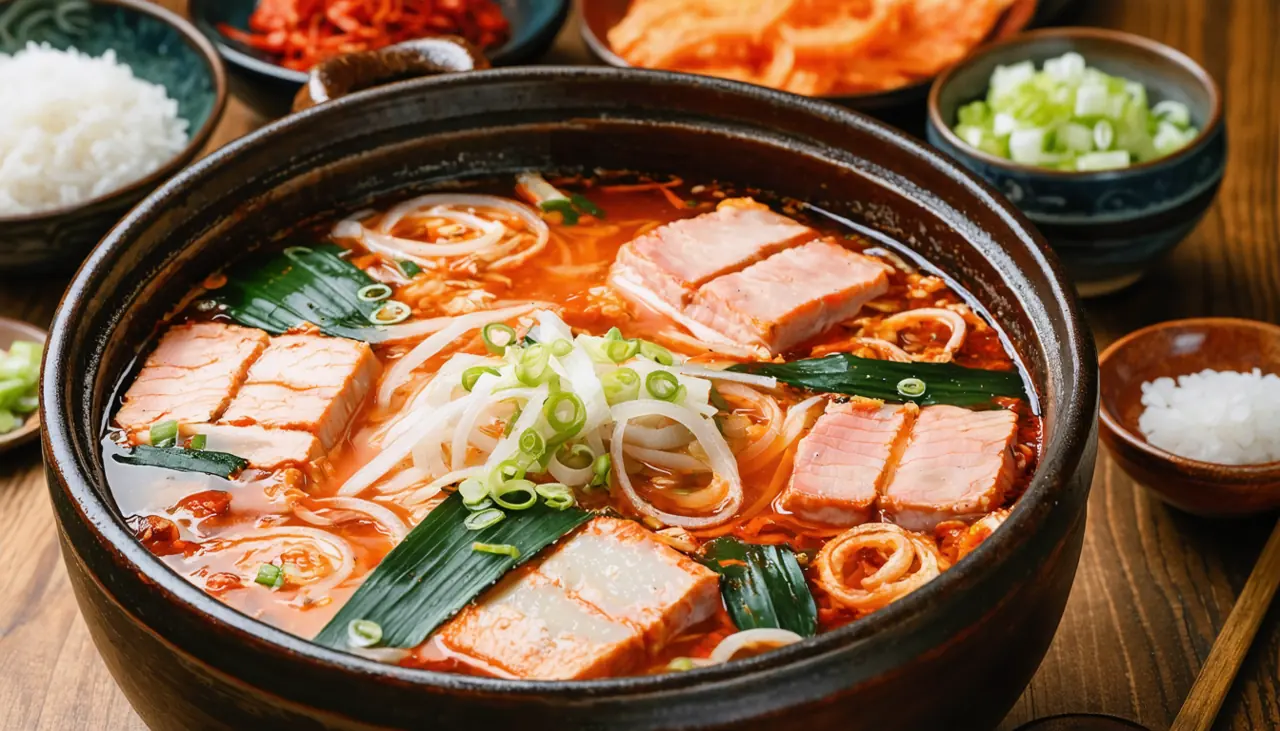
Ragoût de kimchi
Un ragoût savoureux de kimchi bien fermenté, de poitrine de porc et de tofu soyeux, mijoté lentement jusqu'à devenir riche et acidulé.
Portions
Ingrédients
Nutrition
Par portion
Étapes

Brown the pork
Heat the oil in a heavy pot over medium heat. Add the pork belly and cook, stirring now and then, until the fat turns a little golden and the meat is lightly browned. This slow browning renders the fat and builds the base flavor of the whole stew.
- 1 tbsp vegetable oil
- 200 g pork belly
✅ C'est prêt quand : the pork is lightly browned and some fat has rendered into the pot

Sauté the aromatics and kimchi
Add the onion, garlic and ginger to the pot and stir for 1 minute until fragrant. Add the kimchi and cook, stirring, for 4–5 minutes until the kimchi softens and smells deeply savory rather than sharply raw. This step, cooking the kimchi in the pork fat before adding liquid, is what gives the stew its rounded, mellow sourness instead of a flat tang.
- 1/2 onion
- 2 cloves garlic
- 1 tsp ginger
- 400 g kimchi, with its juice
✅ C'est prêt quand : the kimchi has softened and smells rich and savory, not sharply raw

Add chili and simmer
Stir in the gochugaru, gochujang and doenjang (if using), coating the pork and kimchi well. Pour in the stock or water, bring to a boil, then lower the heat and simmer gently, uncovered, for about 15 minutes so the flavors meld and the pork cooks through completely.
- 1 tbsp gochugaru
- 1 tbsp gochujang
- 1 tsp doenjang
- 500 ml stock or water
✅ C'est prêt quand : the broth looks deep red-orange and the pork is fully cooked through

Add the tofu
Gently lower the tofu pieces into the stew without stirring too much, so they keep their shape. Simmer for 5–7 minutes more until the tofu is warmed through and has absorbed some of the stew's flavor.
- 300 g tofu
✅ C'est prêt quand : the tofu is heated through and the stew is bubbling steadily

Season to taste
Taste the broth. If the kimchi was very sour, stir in the sugar to balance it; add salt only if needed, since kimchi and the pastes are already salty. Keep in mind the stew will taste even better after a few more minutes of gentle simmering.
- 1 tsp sugar
- to taste salt
✅ C'est prêt quand : the broth tastes balanced: savory, tangy and lightly spicy, with no raw sharpness

Finish and serve
Scatter the green onions over the top and let the stew bubble for 1 more minute. Serve it straight from the pot, still bubbling, with plenty of steamed rice to soak up the broth. Keep it at a gentle simmer, around 90–100°C (195–212°F), so it stays hot while everyone eats.
- 2 green onions
- to serve steamed rice
Brown the pork
Heat the oil in a heavy pot over medium heat. Add the pork belly and cook, stirring now and then, until the fat turns a little golden and the meat is lightly browned. This slow browning renders the fat and builds the base flavor of the whole stew.
- 1 tbsp vegetable oil
- 200 g pork belly
✅ C'est prêt quand : the pork is lightly browned and some fat has rendered into the pot
Sauté the aromatics and kimchi
Add the onion, garlic and ginger to the pot and stir for 1 minute until fragrant. Add the kimchi and cook, stirring, for 4–5 minutes until the kimchi softens and smells deeply savory rather than sharply raw. This step, cooking the kimchi in the pork fat before adding liquid, is what gives the stew its rounded, mellow sourness instead of a flat tang.
- 1/2 onion
- 2 cloves garlic
- 1 tsp ginger
- 400 g kimchi, with its juice
✅ C'est prêt quand : the kimchi has softened and smells rich and savory, not sharply raw
Add chili and simmer
Stir in the gochugaru, gochujang and doenjang (if using), coating the pork and kimchi well. Pour in the stock or water, bring to a boil, then lower the heat and simmer gently, uncovered, for about 15 minutes so the flavors meld and the pork cooks through completely.
- 1 tbsp gochugaru
- 1 tbsp gochujang
- 1 tsp doenjang
- 500 ml stock or water
✅ C'est prêt quand : the broth looks deep red-orange and the pork is fully cooked through
Add the tofu
Gently lower the tofu pieces into the stew without stirring too much, so they keep their shape. Simmer for 5–7 minutes more until the tofu is warmed through and has absorbed some of the stew's flavor.
- 300 g tofu
✅ C'est prêt quand : the tofu is heated through and the stew is bubbling steadily
Season to taste
Taste the broth. If the kimchi was very sour, stir in the sugar to balance it; add salt only if needed, since kimchi and the pastes are already salty. Keep in mind the stew will taste even better after a few more minutes of gentle simmering.
- 1 tsp sugar
- to taste salt
✅ C'est prêt quand : the broth tastes balanced: savory, tangy and lightly spicy, with no raw sharpness
Finish and serve
Scatter the green onions over the top and let the stew bubble for 1 more minute. Serve it straight from the pot, still bubbling, with plenty of steamed rice to soak up the broth. Keep it at a gentle simmer, around 90–100°C (195–212°F), so it stays hot while everyone eats.
- 2 green onions
- to serve steamed rice
The Story Behind the Dish
Kimchi-jjigae grew out of a simple, thrifty habit: when kimchi grew too sour to enjoy fresh, Korean cooks simmered it with whatever meat and tofu they had, turning deep fermentation into a warming, savory stew. The dish became especially common in postwar Korean households, where pork belly, cheap and widely available, became the classic partner for aged kimchi.
Today it is one of the most cooked meals in Korean homes, often made from the kimchi sitting longest in the fridge rather than from a special shopping trip, and served bubbling in the same pot it was cooked in.
⭐ Why It's Famous
It turns humble, overly sour kimchi into one of Korean cooking's most comforting dishes, prized for its deep, tangy, savory broth.
💡 Fun Fact
Many Korean cooks consider well-aged, sourer kimchi far better for this stew than fresh kimchi, since the fermentation is what gives the broth its characteristic depth.
Korea, nationwide
37.57°N, 126.98°E
Recettes similaires
Comments (0)
No comments yet. Be the first to share your thoughts!