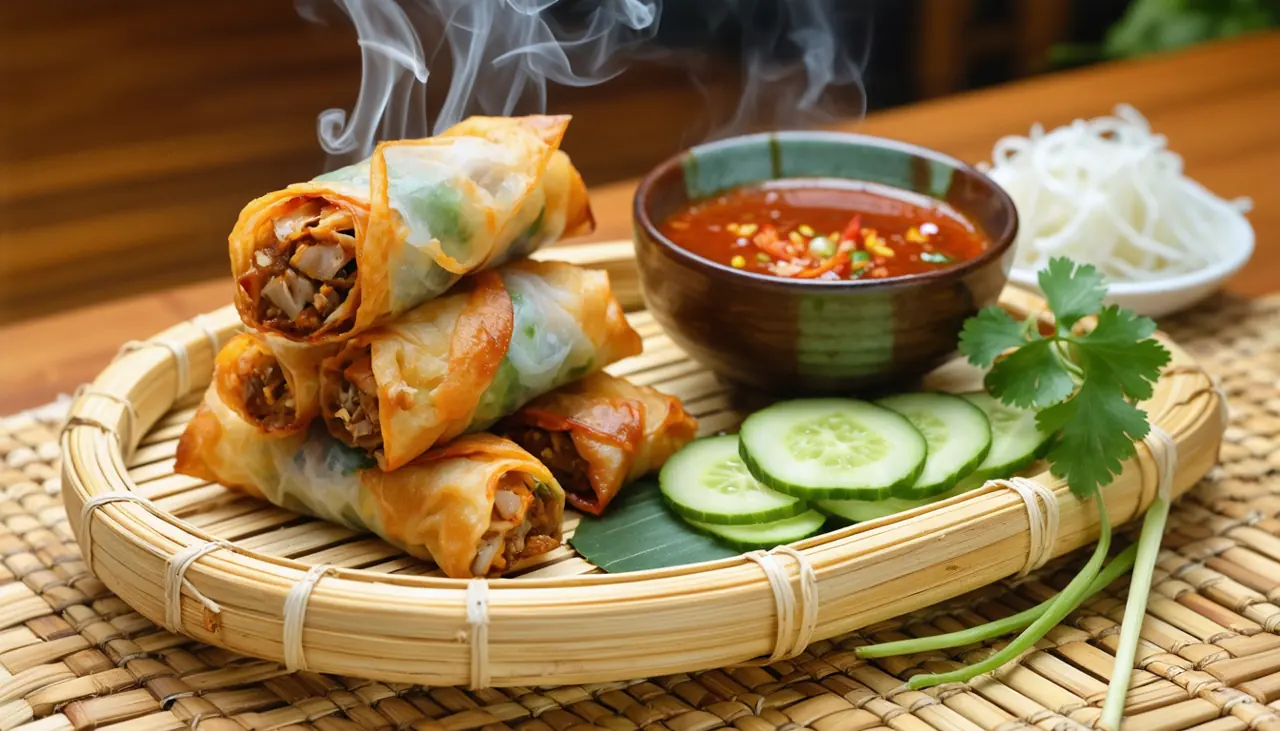
Rouleaux de printemps frits thaïlandais
Rouleaux croustillants farcis de vermicelles, porc et légumes, servis avec une sauce aigre-douce.
Portions
Ingrédients
Nutrition
Par portion
Étapes

Soak noodles and mushrooms
Soak the glass noodles in warm water for 10 minutes until soft and pliable, then drain and snip into short 3–4 cm lengths with scissors. Soak the shiitake mushrooms in warm water for 20 minutes, squeeze dry, then finely chop, discarding the hard stems.
- 50 g glass noodles
- 6 dried shiitake mushrooms
✅ C'est prêt quand : the noodles bend easily without breaking and the mushrooms are soft enough to chop

Cook the filling
Heat the oil in a wok over medium heat, fry the garlic until fragrant, then push it aside and pour in the egg, scrambling it into small pieces. Add the pork and cook, breaking up lumps, until it is no longer pink, then stir in the mushrooms, carrot and cabbage and cook for 2–3 minutes until just softened but not fully limp, since they will cook a little more inside the hot roll later. Add the noodles, soy sauce, oyster sauce, sugar and white pepper, mix well, then take off the heat and fold in the spring onion and bean sprouts raw, for crunch.
- 1 tbsp vegetable oil
- 4 cloves garlic
- 1 egg
- 300 g ground pork
- 6 mushrooms (from step 1)
- 150 g carrot
- 200 g cabbage
- 50 g glass noodles (from step 1)
- 2 tbsp light soy sauce
- 1 tbsp oyster sauce
- 1 tsp sugar
- 1/2 tsp ground white pepper
- 2 spring onions
- 50 g bean sprouts
✅ C'est prêt quand : the pork is fully cooked through, the vegetables are just tender, and everything is well mixed and seasoned

Cool the filling
Spread the filling out on a tray or wide plate so it cools faster, and let it come to room temperature, about 15–20 minutes. This step matters: hot or steamy filling softens the wrappers and tears them while rolling, and traps steam inside that makes the fried rolls soggy instead of crisp.
✅ C'est prêt quand : the filling feels cool to the touch all the way through, with no warmth or steam left

Wrap the rolls
Lay a wrapper on your work surface with one corner pointing toward you, like a diamond, and place about 2 tablespoons of cooled filling near the bottom corner. Fold the bottom corner up over the filling, roll once tightly, then fold in the two side corners like an envelope. Brush the top corner with the flour-and-water paste, roll up firmly to seal, and keep the stack of wrappers covered with a damp cloth so they do not dry out and crack.
- 25 sheets spring roll wrappers
- 1 tbsp + 2 tbsp flour-water paste
✅ C'est prêt quand : the roll is tight, evenly packed with no air pockets, and the seam is sealed shut

Fry until golden
Heat the oil in a wok or deep pot to 160–170°C (320–340°F) and fry the rolls in small batches, turning them often, for 4–5 minutes until deep golden and crisp all over. Do not crowd the pot — too many rolls at once will drop the oil temperature and the rolls will turn greasy instead of crisp. Lift out and drain on a wire rack set over paper towels.
- 1 litre vegetable oil
✅ C'est prêt quand : the rolls are evenly golden brown and sound hollow and crackly when tapped

Serve hot
Let the rolls rest for a minute so the inside settles, then serve immediately while still hot and crisp, with Thai sweet chili sauce for dipping.
- to serve Thai sweet chili sauce
Soak noodles and mushrooms
Soak the glass noodles in warm water for 10 minutes until soft and pliable, then drain and snip into short 3–4 cm lengths with scissors. Soak the shiitake mushrooms in warm water for 20 minutes, squeeze dry, then finely chop, discarding the hard stems.
- 50 g glass noodles
- 6 dried shiitake mushrooms
✅ C'est prêt quand : the noodles bend easily without breaking and the mushrooms are soft enough to chop
Cook the filling
Heat the oil in a wok over medium heat, fry the garlic until fragrant, then push it aside and pour in the egg, scrambling it into small pieces. Add the pork and cook, breaking up lumps, until it is no longer pink, then stir in the mushrooms, carrot and cabbage and cook for 2–3 minutes until just softened but not fully limp, since they will cook a little more inside the hot roll later. Add the noodles, soy sauce, oyster sauce, sugar and white pepper, mix well, then take off the heat and fold in the spring onion and bean sprouts raw, for crunch.
- 1 tbsp vegetable oil
- 4 cloves garlic
- 1 egg
- 300 g ground pork
- 6 mushrooms (from step 1)
- 150 g carrot
- 200 g cabbage
- 50 g glass noodles (from step 1)
- 2 tbsp light soy sauce
- 1 tbsp oyster sauce
- 1 tsp sugar
- 1/2 tsp ground white pepper
- 2 spring onions
- 50 g bean sprouts
✅ C'est prêt quand : the pork is fully cooked through, the vegetables are just tender, and everything is well mixed and seasoned
Cool the filling
Spread the filling out on a tray or wide plate so it cools faster, and let it come to room temperature, about 15–20 minutes. This step matters: hot or steamy filling softens the wrappers and tears them while rolling, and traps steam inside that makes the fried rolls soggy instead of crisp.
✅ C'est prêt quand : the filling feels cool to the touch all the way through, with no warmth or steam left
Wrap the rolls
Lay a wrapper on your work surface with one corner pointing toward you, like a diamond, and place about 2 tablespoons of cooled filling near the bottom corner. Fold the bottom corner up over the filling, roll once tightly, then fold in the two side corners like an envelope. Brush the top corner with the flour-and-water paste, roll up firmly to seal, and keep the stack of wrappers covered with a damp cloth so they do not dry out and crack.
- 25 sheets spring roll wrappers
- 1 tbsp + 2 tbsp flour-water paste
✅ C'est prêt quand : the roll is tight, evenly packed with no air pockets, and the seam is sealed shut
Fry until golden
Heat the oil in a wok or deep pot to 160–170°C (320–340°F) and fry the rolls in small batches, turning them often, for 4–5 minutes until deep golden and crisp all over. Do not crowd the pot — too many rolls at once will drop the oil temperature and the rolls will turn greasy instead of crisp. Lift out and drain on a wire rack set over paper towels.
- 1 litre vegetable oil
✅ C'est prêt quand : the rolls are evenly golden brown and sound hollow and crackly when tapped
Serve hot
Let the rolls rest for a minute so the inside settles, then serve immediately while still hot and crisp, with Thai sweet chili sauce for dipping.
- to serve Thai sweet chili sauce
The Story Behind the Dish
Spring rolls arrived in Thailand with Chinese, mainly Teochew, immigrants who settled in Bangkok and brought their tradition of wrapping leftover vegetables and meat in thin pastry. Over time, Thai cooks adapted the filling with local touches, like glass noodles, white pepper and a sweeter, chili-forward dipping sauce, giving rise to poh pia tod as it is loved today.
It became a fixture of Thai street food and night markets, sold fresh and fried to order, and a common dish at home celebrations and merit-making events, where big batches are rolled by hand.
⭐ Why It's Famous
The contrast between the shatteringly crisp wrapper and the savoury, juicy filling inside makes it one of Thailand's most craved fried snacks.
💡 Fun Fact
In Thai street stalls, spring rolls are often served alongside a smaller fried snack called 'poh pia sod' (fresh, unfried spring rolls), showing both cooking styles side by side.
Thailand, especially Bangkok's Chinese-Thai communities
13.76°N, 100.50°E
Recettes similaires
Comments (0)
No comments yet. Be the first to share your thoughts!