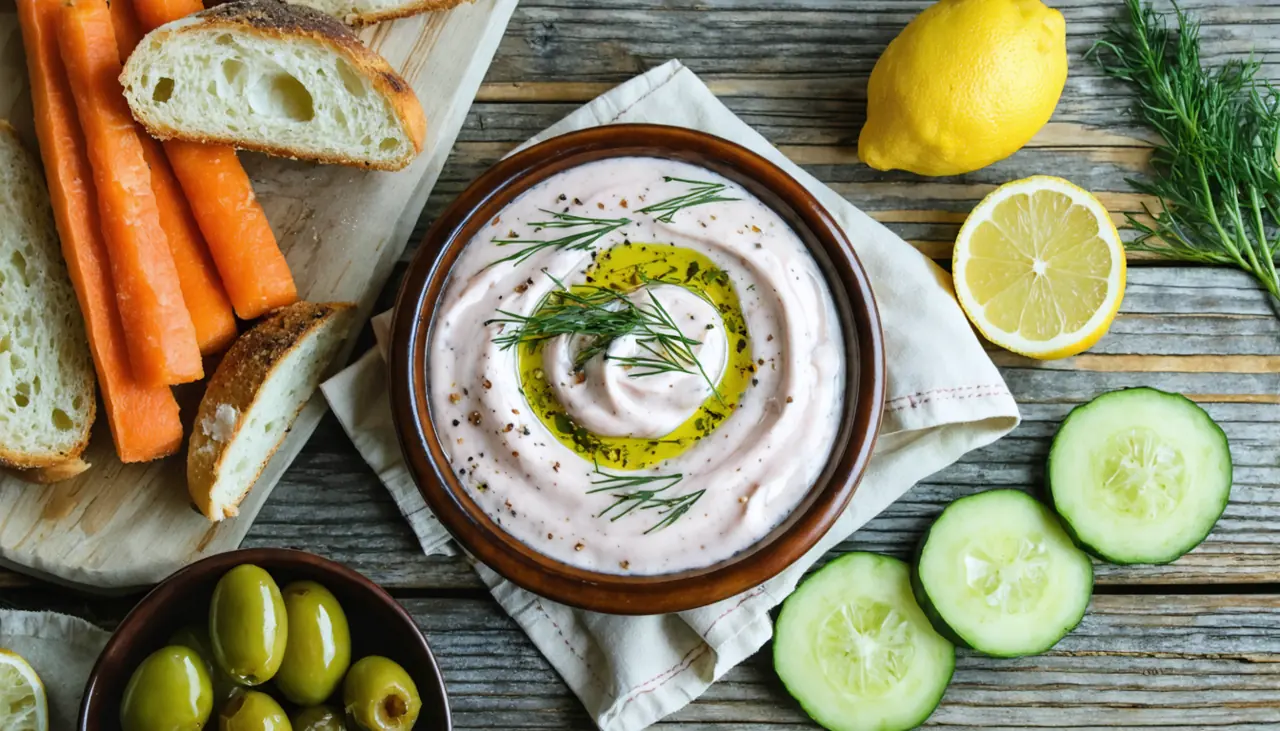
Taramosalata grecque
Tarama fouetté avec du pain trempé, du citron et de l'huile d'olive, pour une mousse rose pâle à tartiner.
Portions
Ingrédients
Nutrition
Par portion
Étapes

Soak the bread
Tear the bread into pieces and drop it into a bowl of cold water for 2–3 minutes until it is fully soft. Lift it out and squeeze it hard between your hands, over and over, until it is as dry as you can get it — a wet dip will never thicken properly.
- 150 g stale bread
- as needed cold water
✅ C'est prêt quand : the bread forms a dense, dry-ish dough that holds its shape when squeezed

Mellow the roe
Put the tarama in a small bowl, cover with cold water and let it stand for 10 minutes; this softens its saltiness and makes it easier to blend. If it comes in a thin membrane or skin, slip it off now. Drain well and pat dry.
- 100 g cured fish roe
✅ C'est prêt quand : the roe looks slightly paler and smells only mildly salty, not sharp
Blend the base
This step is part of Foodie Premium. Subscribe to unlock the full method, cooking mode and every recipe in the library.
Whip in the oil
This step is part of Foodie Premium. Subscribe to unlock the full method, cooking mode and every recipe in the library.
Add lemon and pepper
This step is part of Foodie Premium. Subscribe to unlock the full method, cooking mode and every recipe in the library.
Chill and serve
This step is part of Foodie Premium. Subscribe to unlock the full method, cooking mode and every recipe in the library.
Soak the bread
Tear the bread into pieces and drop it into a bowl of cold water for 2–3 minutes until it is fully soft. Lift it out and squeeze it hard between your hands, over and over, until it is as dry as you can get it — a wet dip will never thicken properly.
- 150 g stale bread
- as needed cold water
✅ C'est prêt quand : the bread forms a dense, dry-ish dough that holds its shape when squeezed
Mellow the roe
Put the tarama in a small bowl, cover with cold water and let it stand for 10 minutes; this softens its saltiness and makes it easier to blend. If it comes in a thin membrane or skin, slip it off now. Drain well and pat dry.
- 100 g cured fish roe
✅ C'est prêt quand : the roe looks slightly paler and smells only mildly salty, not sharp
Blend the base
This step is part of Foodie Premium. Subscribe to unlock the full method, cooking mode and every recipe in the library.
Whip in the oil
This step is part of Foodie Premium. Subscribe to unlock the full method, cooking mode and every recipe in the library.
Add lemon and pepper
This step is part of Foodie Premium. Subscribe to unlock the full method, cooking mode and every recipe in the library.
Chill and serve
This step is part of Foodie Premium. Subscribe to unlock the full method, cooking mode and every recipe in the library.
The Story Behind the Dish
Taramosalata grew out of the need to preserve fish roe by salting it, a method used across the Eastern Mediterranean and Black Sea for centuries. Because it contains no meat or dairy, it became a staple of nistisimo cooking, the dishes Greek Orthodox Christians eat during Lent and other fasting periods, when bread and oil were used to stretch a small amount of a prized, salty ingredient into a dish that could feed a family.
Over time it moved from a fasting food to an everyday mezze, served alongside olives, bread and ouzo at tavernas across the country, each household keeping its own balance of bread, oil and lemon.
⭐ Why It's Famous
It turns a small, intensely salty ingredient into something pale, light and spreadable, proof that good technique can stretch a little into a lot.
💡 Fun Fact
The bright orange taramosalata sold in many supermarkets outside Greece gets its colour from added dye; the traditional version made with pale roe is naturally soft pink or ivory.
Greece, coastal regions and the islands
37.98°N, 23.73°E
Recettes similaires
Comments (0)
No comments yet. Be the first to share your thoughts!