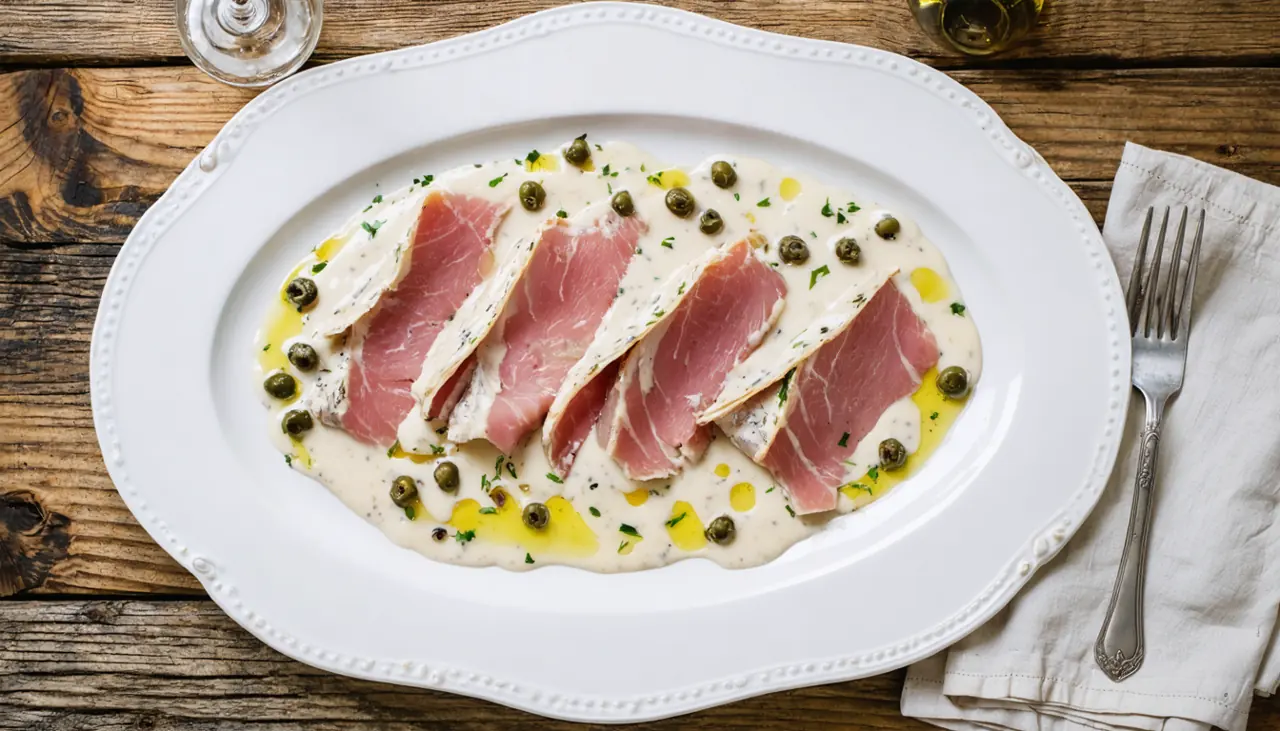
Vitello Tonnato
Fines tranches de veau froid nappées d'une sauce crémeuse au thon et aux câpres, un classique piémontais raffiné.
Portions
Ingrédients
Nutrition
Par portion
Étapes

Prepare the veal
Pat the veal dry with paper towels and season it lightly all over with a little salt. If it's a loose piece rather than a neat roast, tie it with kitchen string so it holds its shape and cooks evenly.
- 900 g veal eye round
✅ C'est prêt quand : the veal is dry, lightly seasoned, and holds a neat, even shape

Poach gently
Put the veal in a pot just large enough to hold it, with the onion, carrot, celery, bay leaves, peppercorns, wine, salt and enough water to cover it by about 2 cm. Bring to a bare simmer — just a few bubbles breaking the surface, never a rolling boil — and cook gently for 45–55 minutes, until a thermometer in the thickest part reads 65°C (150°F). Keep the heat low the whole time; a hard boil tightens and dries out veal, giving you tough, stringy slices instead of silky ones.
- 1 onion
- 1 carrot
- 1 stalk celery
- 2 bay leaves
- 1 tsp black peppercorns
- 250 ml dry white wine
- 1.5 litres water
- 1 tbsp salt
✅ C'est prêt quand : a thermometer reads 65°C (150°F) in the center and the veal feels gently firm, not springy
Cool in the broth
This step is part of Foodie Premium. Subscribe to unlock the full method, cooking mode and every recipe in the library.
Make the tuna sauce
This step is part of Foodie Premium. Subscribe to unlock the full method, cooking mode and every recipe in the library.
Slice the veal thin
This step is part of Foodie Premium. Subscribe to unlock the full method, cooking mode and every recipe in the library.
Assemble and chill
This step is part of Foodie Premium. Subscribe to unlock the full method, cooking mode and every recipe in the library.
Prepare the veal
Pat the veal dry with paper towels and season it lightly all over with a little salt. If it's a loose piece rather than a neat roast, tie it with kitchen string so it holds its shape and cooks evenly.
- 900 g veal eye round
✅ C'est prêt quand : the veal is dry, lightly seasoned, and holds a neat, even shape
Poach gently
Put the veal in a pot just large enough to hold it, with the onion, carrot, celery, bay leaves, peppercorns, wine, salt and enough water to cover it by about 2 cm. Bring to a bare simmer — just a few bubbles breaking the surface, never a rolling boil — and cook gently for 45–55 minutes, until a thermometer in the thickest part reads 65°C (150°F). Keep the heat low the whole time; a hard boil tightens and dries out veal, giving you tough, stringy slices instead of silky ones.
- 1 onion
- 1 carrot
- 1 stalk celery
- 2 bay leaves
- 1 tsp black peppercorns
- 250 ml dry white wine
- 1.5 litres water
- 1 tbsp salt
✅ C'est prêt quand : a thermometer reads 65°C (150°F) in the center and the veal feels gently firm, not springy
Cool in the broth
This step is part of Foodie Premium. Subscribe to unlock the full method, cooking mode and every recipe in the library.
Make the tuna sauce
This step is part of Foodie Premium. Subscribe to unlock the full method, cooking mode and every recipe in the library.
Slice the veal thin
This step is part of Foodie Premium. Subscribe to unlock the full method, cooking mode and every recipe in the library.
Assemble and chill
This step is part of Foodie Premium. Subscribe to unlock the full method, cooking mode and every recipe in the library.
The Story Behind the Dish
Vitello tonnato grew out of the Piedmontese habit of pairing local veal, raised in the region's green hills, with preserved tuna and anchovies brought up from Liguria along old salt and trade routes. Combining a landlocked meat with a seaside fish into one cold, creamy dish was a clever, resourceful kind of cooking long before it became an elegant restaurant classic.
By the late 1800s the dish had settled into the form we know today, and it became a fixture of festive tables across northern Italy, especially at Easter and New Year's Eve, when a cold, make-ahead main course that only improves with a day's rest in the fridge is exactly what a busy host needs.
⭐ Why It's Famous
It turns humble pantry staples — canned tuna, anchovies, capers — into something genuinely elegant, and it's prized because it tastes even better the next day, making it a stress-free centerpiece for celebrations.
💡 Fun Fact
The original Piedmontese sauce had no mayonnaise at all; cooks mashed hard-boiled egg yolks with oil and tuna instead. The creamy, egg-yolk mayonnaise version most people make today only became standard in the 20th century.
Piedmont, northwestern Italy
45.07°N, 7.69°E
Recettes similaires
Comments (0)
No comments yet. Be the first to share your thoughts!