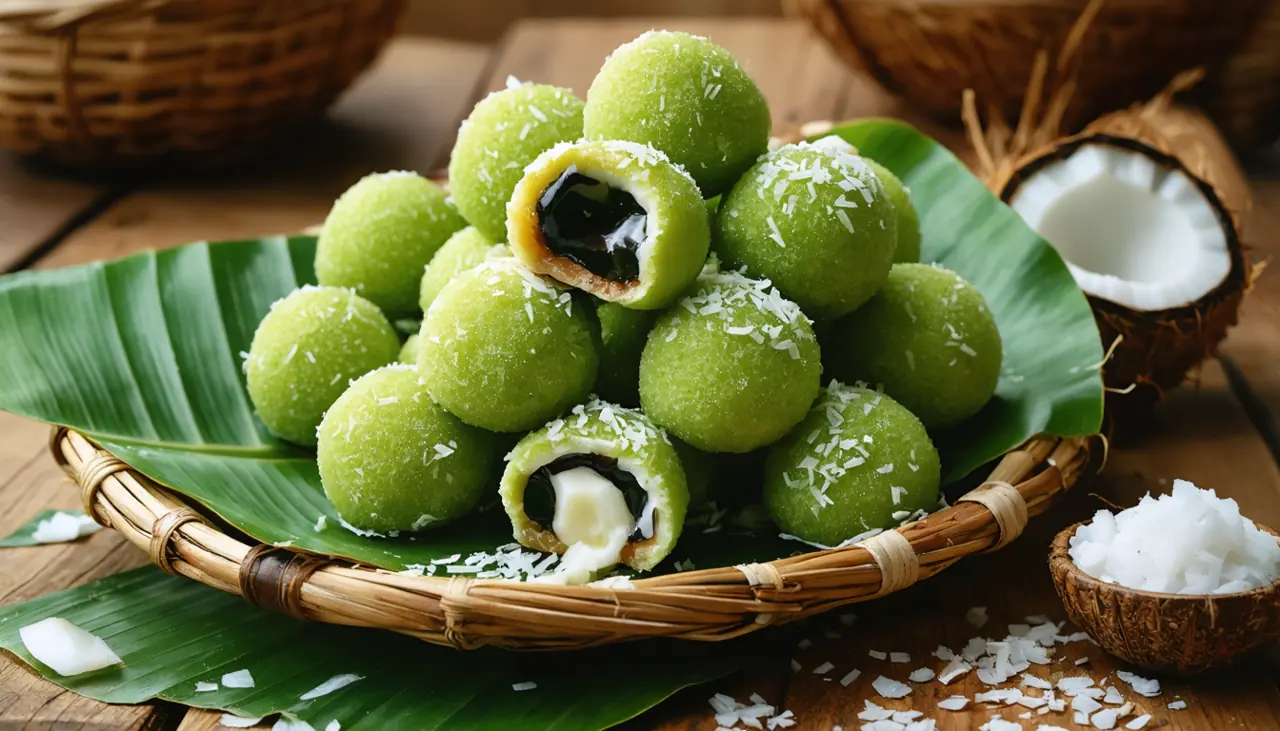
Klepon (Pandan Rice Balls with Molten Palm Sugar)
Soft, chewy balls of pandan-scented glutinous rice dough, each one hiding a pocket of melted palm sugar that bursts out on the first bite. Rolled in lightly salted steamed coconut, they're one of Indonesia's best-loved market snacks.
Servings
Ingredients
Nutrition
Per serving
Steps

Blend the pandan juice
Blend the leaf pieces with the water until smooth, then strain through a fine sieve or a piece of muslin cloth, pressing well to squeeze out all the green juice. Discard the fibrous pulp — the juice is what colours and perfumes the dough naturally, with no food colouring needed.
- 10 leaves
- 250 ml water
✅ Done when: the strained juice is bright green and you have at least 180 ml

Season and steam the coconut
Toss the grated coconut with the salt and the knotted leaf, then steam over gently simmering water for 8–10 minutes. Steaming firms up the coconut and keeps it fresh for longer, so it won't turn sour before the klepon are eaten.
- 200 g grated coconut
- 1/4 tsp salt
- 1 leaf
✅ Done when: the coconut is warm through and smells sweet rather than raw

Make the dough
In a bowl, mix the glutinous rice flour with the salt. Pour in the juice a little at a time, kneading with your hand, until you get a smooth, soft dough that holds together without cracking when you flatten a small piece between your fingers — that bend test tells you the dough has enough liquid and won't split open in the boiling water.
- 250 g glutinous rice flour
- 1/4 tsp salt
- 180 ml juice (from step 1)
✅ Done when: a flattened piece of dough bends at the edge instead of cracking

Shape and fill the balls
Pinch off pieces of dough about the size of a walnut (around 15 g) and roll into balls. Flatten each one slightly in your palm, press a dent in the centre, add about 1 teaspoon of chopped palm sugar, then pull the dough back up and around the filling, pinching the seam closed and rolling it smooth again. Make sure there are no cracks or open seams — any gap lets the melted sugar leak out into the water instead of staying trapped inside.
- 100 g palm sugar
✅ Done when: each ball is smooth, fully sealed, and shows no cracks when rolled between your palms

Boil the klepon
Bring a large pot of water to a rolling boil. Drop in the filled balls, a batch at a time without crowding the pot, and boil until they float to the surface and look slightly translucent, 5–7 minutes. Lift out with a slotted spoon and let them drain for a few seconds.
- 2 litres water
✅ Done when: the balls float and turn a slightly glossy, translucent green

Coat in coconut and serve
While the klepon are still warm, roll them straight away in the steamed grated coconut until completely coated, so the coconut sticks to the hot, slightly tacky surface. Serve the same day, ideally within a few hours, while the palm sugar inside is still soft and molten.
- 200 g steamed grated coconut (from step 2)
Blend the pandan juice
Blend the leaf pieces with the water until smooth, then strain through a fine sieve or a piece of muslin cloth, pressing well to squeeze out all the green juice. Discard the fibrous pulp — the juice is what colours and perfumes the dough naturally, with no food colouring needed.
- 10 leaves
- 250 ml water
✅ Done when: the strained juice is bright green and you have at least 180 ml
Season and steam the coconut
Toss the grated coconut with the salt and the knotted leaf, then steam over gently simmering water for 8–10 minutes. Steaming firms up the coconut and keeps it fresh for longer, so it won't turn sour before the klepon are eaten.
- 200 g grated coconut
- 1/4 tsp salt
- 1 leaf
✅ Done when: the coconut is warm through and smells sweet rather than raw
Make the dough
In a bowl, mix the glutinous rice flour with the salt. Pour in the juice a little at a time, kneading with your hand, until you get a smooth, soft dough that holds together without cracking when you flatten a small piece between your fingers — that bend test tells you the dough has enough liquid and won't split open in the boiling water.
- 250 g glutinous rice flour
- 1/4 tsp salt
- 180 ml juice (from step 1)
✅ Done when: a flattened piece of dough bends at the edge instead of cracking
Shape and fill the balls
Pinch off pieces of dough about the size of a walnut (around 15 g) and roll into balls. Flatten each one slightly in your palm, press a dent in the centre, add about 1 teaspoon of chopped palm sugar, then pull the dough back up and around the filling, pinching the seam closed and rolling it smooth again. Make sure there are no cracks or open seams — any gap lets the melted sugar leak out into the water instead of staying trapped inside.
- 100 g palm sugar
✅ Done when: each ball is smooth, fully sealed, and shows no cracks when rolled between your palms
Boil the klepon
Bring a large pot of water to a rolling boil. Drop in the filled balls, a batch at a time without crowding the pot, and boil until they float to the surface and look slightly translucent, 5–7 minutes. Lift out with a slotted spoon and let them drain for a few seconds.
- 2 litres water
✅ Done when: the balls float and turn a slightly glossy, translucent green
Coat in coconut and serve
While the klepon are still warm, roll them straight away in the steamed grated coconut until completely coated, so the coconut sticks to the hot, slightly tacky surface. Serve the same day, ideally within a few hours, while the palm sugar inside is still soft and molten.
- 200 g steamed grated coconut (from step 2)
The Story Behind the Dish
Klepon belongs to the vast family of jajanan pasar, the sweet and savoury snacks sold in Indonesia's traditional markets. It is thought to have originated in Java, made from the glutinous rice flour and palm sugar that have long been staples of Javanese cooking, and it later spread across the archipelago, including to Bali and Sumatra, sometimes under slightly different names.
Traditionally the little balls are boiled fresh each morning by home cooks or market vendors, then rolled in coconut and sold still warm, often piled onto a banana-leaf tray so the next customer gets them while the sugar inside is still soft.
⭐ Why It's Famous
Klepon is loved for its surprise: a chewy, mild pandan-scented shell that gives way to a sudden rush of warm, syrupy palm sugar, all finished with the light saltiness of coconut.
💡 Fun Fact
The green colour of klepon traditionally comes only from pandan leaves (sometimes with a touch of suji leaf), never from artificial dye, which is why older recipes insist on fresh leaves rather than extract.
Java, Indonesia
-7.80°S, 110.37°E
Related recipes
Comments (0)
No comments yet. Be the first to share your thoughts!