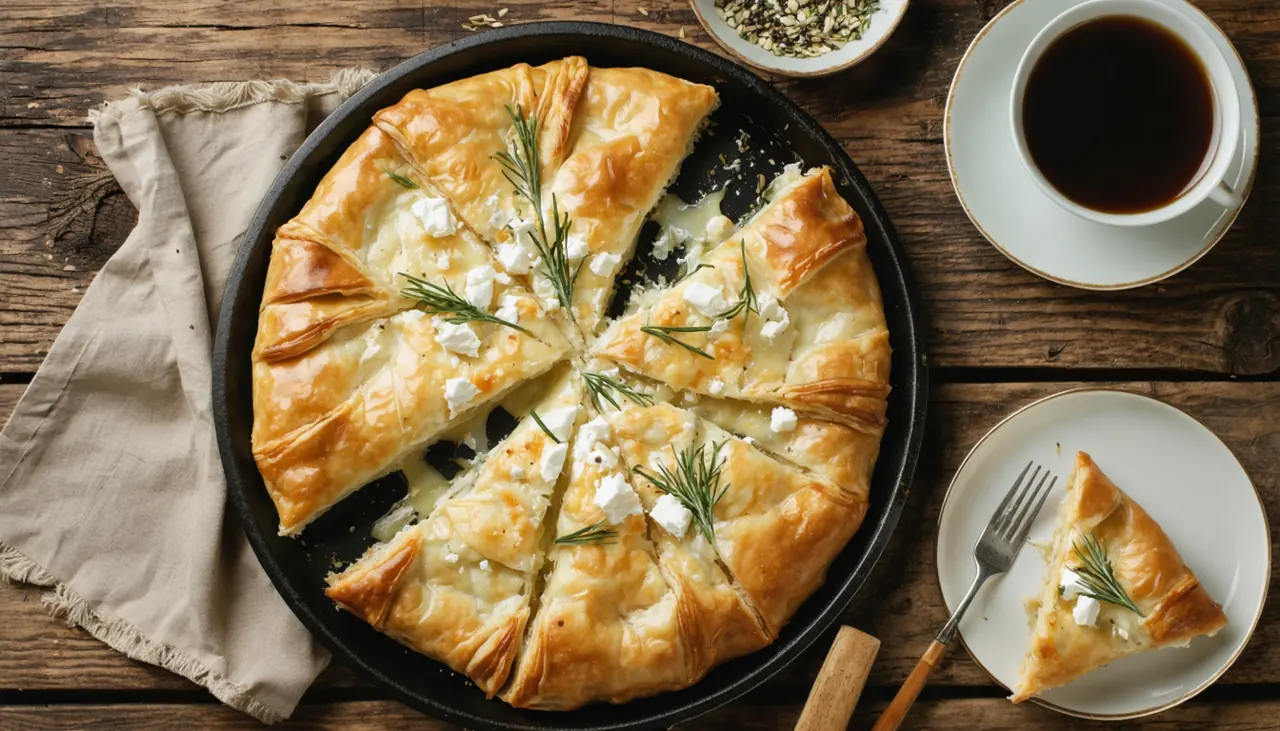
Tiropita (tourte au fromage grecque)
Fines feuilles de phyllo croustillantes et beurrées, garnies d'un mélange riche de feta et d'autres fromages grecs.
Portions
Ingrédients
Nutrition
Par portion
Étapes

Make the cheese filling
In a large bowl, crumble the feta with your fingers, leaving some texture rather than mashing it smooth. Add the ricotta, grated kefalotyri, eggs, yogurt, pepper, nutmeg and dill, then mix well with a fork until creamy and evenly combined.
- 300 g feta cheese
- 200 g ricotta or anthotyro
- 100 g kefalotyri or parmesan
- 4 eggs
- 100 g Greek yogurt
- 1/2 tsp black pepper
- 1 pinch nutmeg
- 2 tbsp dill or mint
✅ C'est prêt quand : the mixture is thick and creamy, with no large lumps of cheese left, and holds together like a soft, moist paste

Butter and layer base
Brush a 30x20 cm (12x8 in) baking pan generously with melted butter and olive oil. Lay one phyllo sheet in the pan, letting the edges hang over the sides, and brush it lightly with butter; repeat with half the sheets, buttering each one before adding the next. This buttering between every layer is what makes the baked crust shatter into flaky sheets instead of baking into one dense slab.
- about 10 sheets phyllo pastry
- 90 g melted butter
- 2 tbsp olive oil
✅ C'est prêt quand : half the phyllo sheets are stacked in the pan, each one glistening with butter with no dry, unbrushed patches

Add the filling
Spoon the cheese filling from step 1 over the phyllo base and spread it into an even layer right out to the edges with the back of a spoon.
- 300 g cheese filling (from step 1)
- 4 cheese filling (from step 1)
✅ C'est prêt quand : the filling covers the whole base evenly, about 1.5 cm thick

Layer the top
Cover the filling with the remaining phyllo sheets, brushing each one with butter as before. Fold the overhanging edges of the bottom sheets up and over the top to seal the pie, then loosely scrunch the last sheet or two instead of laying them flat before placing them on top. This scrunching gives the crust its craggy, extra-crisp finish, a traditional home-baker's touch.
- about 10 sheets phyllo pastry
- 90 g melted butter
✅ C'est prêt quand : the pie is fully enclosed in buttered phyllo with no filling visible, and the top looks ruffled rather than flat

Score and bake
With a sharp knife, score the top layers into squares or diamonds without cutting all the way through to the filling; this stops the crust from shattering unevenly when you cut it later. Sprinkle the water over the top, which helps the top sheets curl and crackle instead of puffing into bubbles. Bake in a preheated oven at 180°C (350°F) for 40–45 minutes.
- 1 tbsp water
✅ C'est prêt quand : deep golden brown all over and crisp enough to make a crackling sound when tapped

Rest and serve
Remove the pie from the oven and let it rest for 10–15 minutes; cutting it too soon lets the warm, soft filling ooze out and makes messy slices. Cut along the scored lines into squares and serve warm or at room temperature.
✅ C'est prêt quand : the pie has firmed up enough to lift out clean, neat squares
Make the cheese filling
In a large bowl, crumble the feta with your fingers, leaving some texture rather than mashing it smooth. Add the ricotta, grated kefalotyri, eggs, yogurt, pepper, nutmeg and dill, then mix well with a fork until creamy and evenly combined.
- 300 g feta cheese
- 200 g ricotta or anthotyro
- 100 g kefalotyri or parmesan
- 4 eggs
- 100 g Greek yogurt
- 1/2 tsp black pepper
- 1 pinch nutmeg
- 2 tbsp dill or mint
✅ C'est prêt quand : the mixture is thick and creamy, with no large lumps of cheese left, and holds together like a soft, moist paste
Butter and layer base
Brush a 30x20 cm (12x8 in) baking pan generously with melted butter and olive oil. Lay one phyllo sheet in the pan, letting the edges hang over the sides, and brush it lightly with butter; repeat with half the sheets, buttering each one before adding the next. This buttering between every layer is what makes the baked crust shatter into flaky sheets instead of baking into one dense slab.
- about 10 sheets phyllo pastry
- 90 g melted butter
- 2 tbsp olive oil
✅ C'est prêt quand : half the phyllo sheets are stacked in the pan, each one glistening with butter with no dry, unbrushed patches
Add the filling
Spoon the cheese filling from step 1 over the phyllo base and spread it into an even layer right out to the edges with the back of a spoon.
- 300 g cheese filling (from step 1)
- 4 cheese filling (from step 1)
✅ C'est prêt quand : the filling covers the whole base evenly, about 1.5 cm thick
Layer the top
Cover the filling with the remaining phyllo sheets, brushing each one with butter as before. Fold the overhanging edges of the bottom sheets up and over the top to seal the pie, then loosely scrunch the last sheet or two instead of laying them flat before placing them on top. This scrunching gives the crust its craggy, extra-crisp finish, a traditional home-baker's touch.
- about 10 sheets phyllo pastry
- 90 g melted butter
✅ C'est prêt quand : the pie is fully enclosed in buttered phyllo with no filling visible, and the top looks ruffled rather than flat
Score and bake
With a sharp knife, score the top layers into squares or diamonds without cutting all the way through to the filling; this stops the crust from shattering unevenly when you cut it later. Sprinkle the water over the top, which helps the top sheets curl and crackle instead of puffing into bubbles. Bake in a preheated oven at 180°C (350°F) for 40–45 minutes.
- 1 tbsp water
✅ C'est prêt quand : deep golden brown all over and crisp enough to make a crackling sound when tapped
Rest and serve
Remove the pie from the oven and let it rest for 10–15 minutes; cutting it too soon lets the warm, soft filling ooze out and makes messy slices. Cut along the scored lines into squares and serve warm or at room temperature.
✅ C'est prêt quand : the pie has firmed up enough to lift out clean, neat squares
The Story Behind the Dish
Cheese-filled pies have been part of Greek cooking since antiquity, when early flatbreads were baked with cheese worked into the dough. Over centuries, Byzantine cooks developed the technique of stretching dough into paper-thin sheets, the ancestor of today's phyllo, which allowed the cheese filling to be wrapped in many crisp, buttery layers instead of a single thick crust.
Today tiropita is sold in bakeries on nearly every street corner in Greece, eaten for breakfast with coffee, packed as a school or work snack, or baked at home in a big tray for the whole family. Every region, and often every grandmother, has its own favourite blend of local cheeses.
⭐ Why It's Famous
Crisp, buttery layers wrapped around a tangy, salty, custard-like cheese filling make it one of Greece's best-loved snacks, equally at home at a bakery counter or on a family table.
💡 Fun Fact
In Greek bakeries, tiropita is sold from early morning alongside coffee right through to late at night, making it one of the country's most reliable grab-and-go foods.
Greece, countrywide
37.98°N, 23.73°E
Recettes similaires

Comments (0)
No comments yet. Be the first to share your thoughts!